 jobdayta.com
 Jobs and Career in Finance Industry
Finance encompasses the management, creation, and study of money, investments, and other financial instruments critical to both individuals and businesses. It involves key areas such as budgeting, saving, lending, and borrowing, which drive economic growth and stability. Capital markets, banking systems, and financial institutions play essential roles in allocating resources efficiently and managing risk. Understanding financial principles supports better decision-making and wealth accumulation.
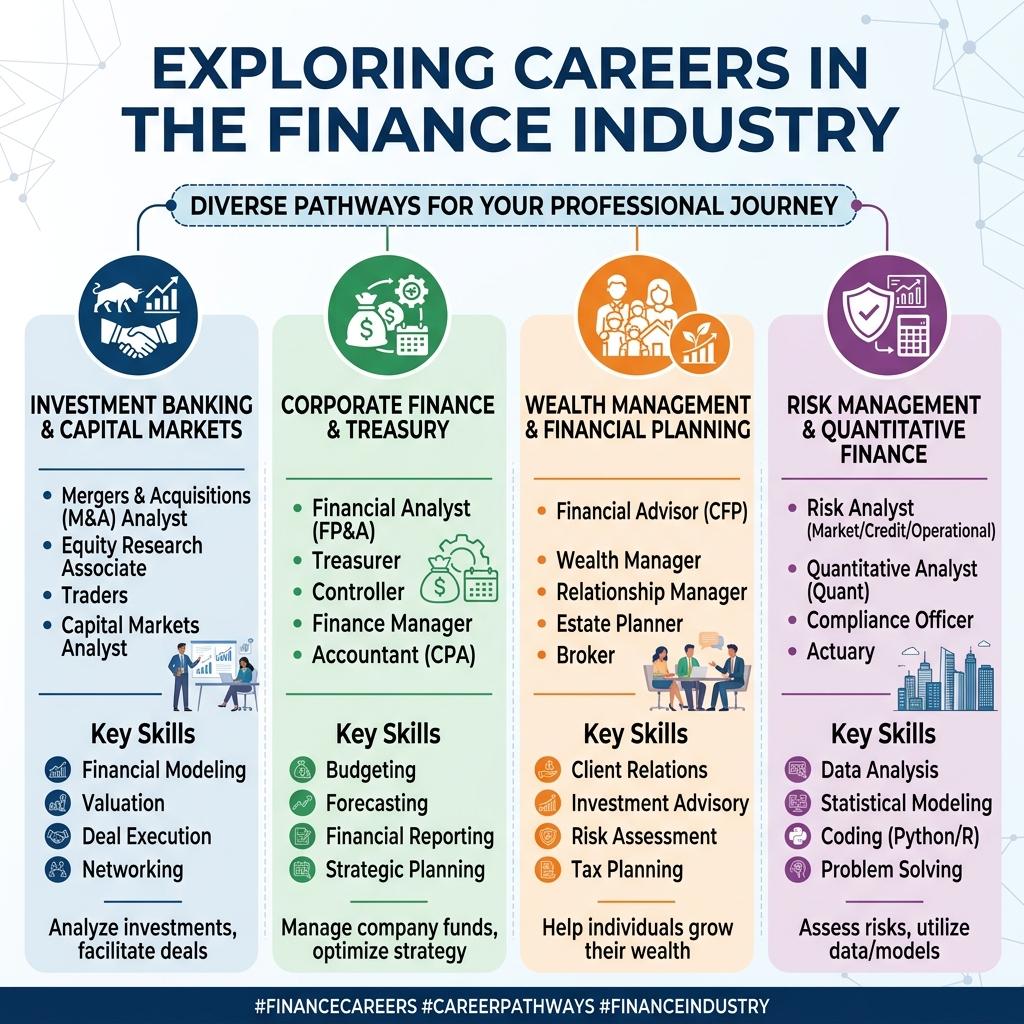
What are the main career paths in the finance industry?
The finance industry offers diverse career trajectories tailored to different skill sets. The most prominent paths include:
- Investment Banking: Advising entities on raising capital, mergers, and acquisitions.
- Corporate Finance: Managing a company's internal financial activities, including budgeting and forecasting.
- Wealth Management: Advising high-net-worth individuals on personal investments and estate planning.
- Private Equity & Venture Capital: Investing in private companies or early-stage startups for long-term growth.
- Risk Management: Identifying, assessing, and mitigating financial risks within an organization.
What is the difference between investment banking and corporate finance?
While both fields deal with maximizing financial performance, their focus, clientele, and lifestyles differ significantly.
| Feature | Investment Banking | Corporate Finance |
|---|---|---|
| Clientele | External clients (corporations, governments) | Internal (the company you work for) |
| Core Duty | Capital raising, M&A advising | Capital budgeting, daily financial operations |
| Work-Life Balance | Notoriously demanding (80+ hours/week) | Generally stable (40-50 hours/week) |
What certifications are most valuable for a finance career?
Depending on your specific career goals, earning professional certifications can significantly boost your employability, credibility, and salary potential.
- CFA (Chartered Financial Analyst): The gold standard for investment management, asset management, and equity research.
- CPA (Certified Public Accountant): Essential for corporate accounting, auditing, and tax-focused roles.
- CFP (CERTIFIED FINANCIAL PLANNER™): Crucial for wealth management and personal financial advising.
- FRM (Financial Risk Manager): Highly valued for risk management roles in banks, hedge funds, and insurance companies.
What are the typical entry-level base salaries for finance roles?
Entry-level compensation varies widely based on the specific sector, geographic location, and firm size. Below is a general estimate of starting base salaries in the US:
| Finance Role | Estimated Base Salary (USD) |
|---|---|
| Investment Banking Analyst | $100,000 - $120,000 |
| Corporate Financial Analyst | $60,000 - $80,000 |
| Wealth Management Associate | $55,000 - $75,000 |
| Risk Analyst | $65,000 - $85,000 |
Note: These figures exclude performance bonuses, which can be substantial (often 50-100% of base pay in investment banking).
What are the essential skills needed to succeed in finance?
Success in the finance industry requires a well-rounded blend of highly technical quantitative abilities and strong interpersonal skills.
- Hard Skills:
- Financial Modeling: Building accurate Excel models to forecast future performance.
- Data Analysis: Proficiency in SQL, Python, or advanced Excel to interpret large datasets.
- Accounting Knowledge: Deep understanding of balance sheets, income statements, and cash flows.
- Soft Skills:
- Communication: Translating complex financial data into actionable insights for non-financial stakeholders.
- Attention to Detail: Avoiding costly errors in calculations, compliance, and reporting.
How can someone transition into finance from a non-finance background?
Transitioning into finance is entirely possible with strategic planning and dedication. Follow these key steps:
- Leverage Transferable Skills: Highlight analytical, problem-solving, or project management skills from your previous career on your resume.
- Pursue Education: Enroll in a top-tier MBA program or study for the CFA Level 1 exam to demonstrate commitment and gain necessary technical knowledge.
- Network Aggressively: Attend industry events, utilize LinkedIn, and conduct informational interviews with current finance professionals.
- Start in Adjacent Roles: Look for opportunities in FinTech, corporate strategy, or financial consulting before moving into traditional banking or investing roles.
What are the typical stages of career progression in investment banking?
Investment banking features a rigid, well-defined corporate hierarchy. The typical career progression moves through the following stages:
- Analyst (2-3 years): The entry-level role focused on heavy financial modeling, research, and creating pitch books.
- Associate (3-4 years): Often post-MBA hires or promoted Analysts. They check the Analysts' work and manage daily deal execution.
- Vice President / VP (3-4 years): Manages day-to-day client relationships and oversees the Associates and Analysts.
- Director (2-3 years): Focuses heavily on sourcing new deals and managing senior-level client relationships.
- Managing Director (MD): The top of the hierarchy, solely responsible for bringing in new business and generating revenue.
How is artificial intelligence changing finance jobs?
Artificial Intelligence (AI) is rapidly transforming the finance industry by automating routine tasks and dramatically enhancing analytical capabilities.
For entry-level roles, AI is taking over repetitive data entry, basic report generation, and initial compliance checks. This shift means junior professionals must adapt by moving away from rote task execution toward interpreting AI-generated data and strategic decision-making.
Furthermore, AI is creating new, highly lucrative career opportunities within finance. Roles for quantitative analysts (quants) and financial data scientists, who develop machine learning algorithms for high-frequency trading and predictive risk modeling, are in massive demand.
What does a corporate financial analyst actually do?
A corporate financial analyst plays a vital role in ensuring a company's internal financial health. Instead of advising external clients, they help their own company make sound business decisions. Core responsibilities include:
- Budgeting and Forecasting: Preparing annual budgets and predicting future revenues and expenses.
- Variance Analysis: Comparing actual financial results against budgeted forecasts and explaining the discrepancies.
- Performance Reporting: Creating financial dashboards and presentations for senior management to track key performance indicators (KPIs).
- Capital Assessment: Evaluating the financial viability and return on investment (ROI) of new internal projects, expansions, or equipment purchases.
How important is networking for career development in finance?
Networking is absolutely critical for career advancement in the finance industry. In highly competitive sectors like private equity, venture capital, and investment banking, many lucrative job openings are never publicly posted. Instead, they are filled exclusively through internal referrals and industry connections.
Effective networking provides access to this "hidden job market" and offers invaluable mentorship opportunities. It helps young professionals learn about the nuances of different firm cultures.
To build a strong network, professionals should actively participate in university alumni associations and industry conferences. Cold outreach via LinkedIn for "informational interviews" is also a widely accepted and expected practice for aspiring finance professionals.