 jobdayta.com
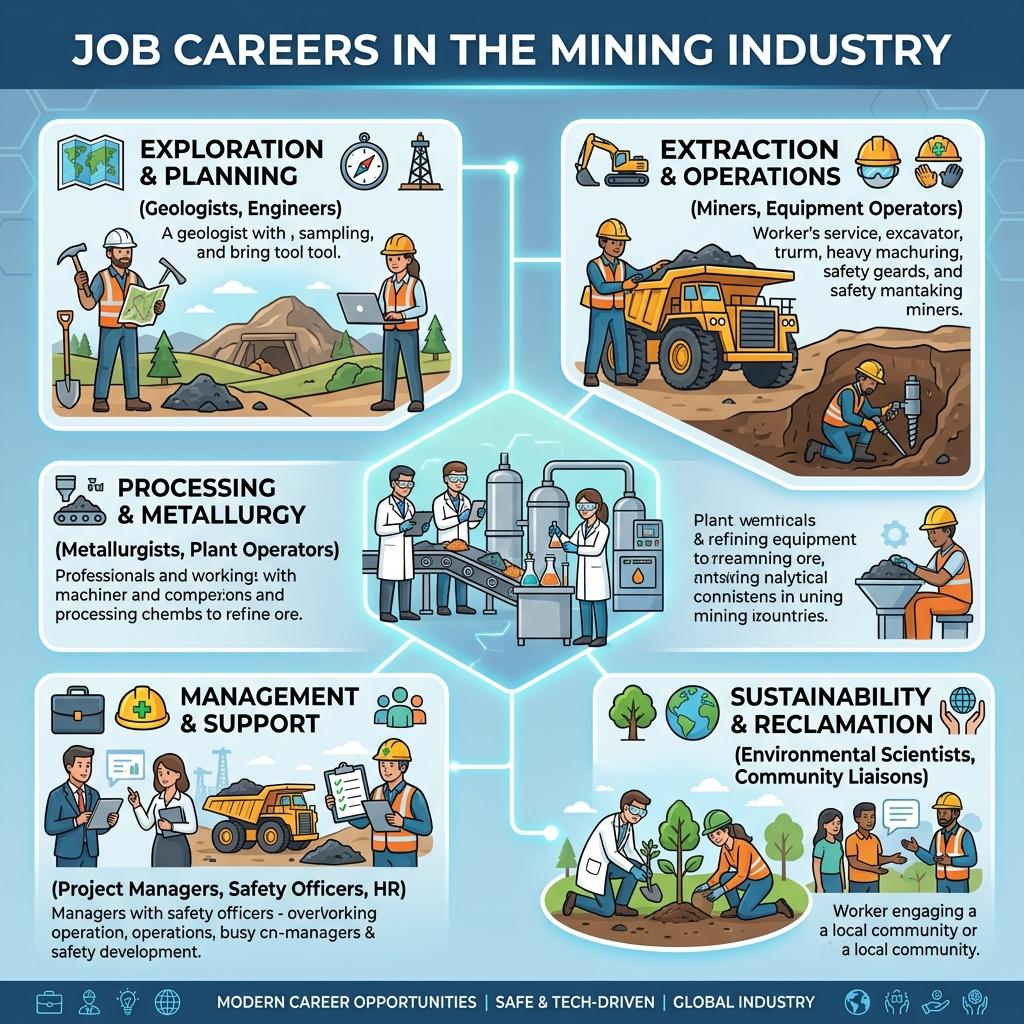
 Jobs and Career in Mining Industry
Mining involves extracting valuable minerals and resources from the Earth's crust, including metals like gold, silver, copper, and industrial minerals such as coal and salt. Advanced techniques such as open-pit, underground, and placer mining optimize resource recovery while minimizing environmental impact. Modern mining integrates geological surveying, mineral processing, and sustainable practices to enhance operational efficiency and safety. The mining sector significantly contributes to global economies by supplying essential raw materials for manufacturing, construction, and technology industries.
What are the basic educational requirements for an entry-level job in the mining industry?
Educational requirements in the mining industry vary significantly depending on the career path you choose. Generally, there are two main tracks:
- Operational and Trades: For roles like equipment operators, drillers, or laborers, a high school diploma or equivalent is usually sufficient. Companies typically provide extensive on-the-job training. Trade apprenticeships require vocational certifications.
- Professional and Technical: Roles such as geologists, mining engineers, and metallurgists require a minimum of a bachelor's degree in a relevant STEM field.
Which roles are currently in the highest demand within the mining sector?
Due to industry growth and an aging workforce, the mining sector is currently experiencing a severe skills shortage. The most highly sought-after roles span across multiple disciplines:
| Category | High-Demand Roles |
|---|---|
| Engineering | Mining Engineers, Geotechnical Engineers |
| Technology | Data Scientists, Automation Specialists |
| Skilled Trades | Heavy Duty Mechanics, Electricians |
| Sciences | Exploration Geologists, Metallurgists |
What does a typical career progression look like for a Mining Engineer?
Mining engineering offers a highly structured and rewarding career path, often leading directly into executive leadership. A standard progression looks like this:
- Graduate Engineer: Focuses on rotating through different mine departments (drill/blast, planning, ventilation) to learn site basics.
- Mine Planning Engineer: Takes on specific responsibilities designing short-term or long-term extraction plans.
- Senior Engineer: Manages a team of engineers and oversees major technical projects.
- Mine Manager / Superintendent: Oversees entire site operations, budgets, and safety compliance.
How is technology changing career opportunities in mining?
Technology is fundamentally shifting mining from purely manual labor to high-tech, precision operations. Automation, artificial intelligence, and the Internet of Things (IoT) have created massive demand for technology professionals within the sector.
Traditional miners are upskilling to operate autonomous drillers and loaders from comfortable, remote control centers located hundreds of miles away from the physical mine. Consequently, IT professionals, software developers, drone operators, and cybersecurity experts are now just as critical to a modern mining company as geologists.
What kind of safety training is mandatory for new mining employees?
Safety is the foundational pillar of the mining industry. Before stepping onto any active mine site, all new employees—regardless of their role—must complete rigorous safety inductions.
- Regulatory Training: In the US, this means completing MSHA (Mine Safety and Health Administration) certification. Other countries have similar statutory equivalents.
- Site-Specific Induction: Covers local hazards, emergency evacuation protocols, and restricted areas.
- Equipment Ticketing: Specialized training and licensing for operating specific heavy machinery safely.
What is a FIFO lifestyle, and how does it affect mining careers?
FIFO stands for "Fly-In, Fly-Out." It is a standard employment arrangement for mines located in remote areas where building a permanent town is impractical. Companies fly workers to the site, provide them with food and camp accommodation, and fly them home after their shift block.
Typical rosters might be 14 days of work followed by 7 days of rest. While FIFO careers offer exceptionally high salaries and extended periods of time off, the lifestyle requires resilience due to long periods away from family and friends.
Are there career opportunities in environmental sustainability within mining?
Absolutely. ESG (Environmental, Social, and Governance) roles are currently the fastest-growing segment in the mining industry. Companies are under strict regulatory and public pressure to minimize their ecological footprint.
Key sustainability roles include:
- Environmental Scientists: Monitoring water and air quality around the mine.
- Reclamation Specialists: Designing plans to restore the land to its natural state after mining concludes.
- Community Relations Advisors: Liaising with indigenous groups and local stakeholders.
How do salaries in the mining industry compare to other sectors?
Mining consistently ranks among the highest-paying industrial sectors globally. The premium pay compensates for remote working locations, shift work, and the specialized technical skills required.
| Career Level | Salary Comparison (vs. General Industry) |
|---|---|
| Entry-Level (Labor/Grads) | 15% - 25% higher |
| Skilled Trades | 20% - 30% higher |
| Senior Engineering/Management | 10% - 20% higher, plus large bonuses |
What transferable skills are most valuable for transitioning into the mining industry?
Professionals from construction, military, oil and gas, and tech sectors often transition very smoothly into mining. The most valuable transferable skills include:
- Operational Skills
- Heavy machinery operation and maintenance
- Logistics and supply chain management
- Soft Skills
- Strict adherence to safety protocols (highly valued in military vets)
- Crisis management and problem-solving
- Technical Skills
- Large-scale project management
- Data analytics and network engineering
How will the global energy transition affect future mining jobs?
The shift towards renewable energy and electric vehicles (EVs) is triggering a massive mining boom. The world requires enormous amounts of "critical minerals"—such as lithium, cobalt, copper, and nickel—to build solar panels, wind turbines, and EV batteries.
While traditional thermal coal mining jobs are expected to decline over the long term, overall employment in the mining sector is projected to surge. This transition secures a strong, long-term career outlook for modern mining professionals dedicated to supplying the green economy.