 jobdayta.com
 Jobs and Career in Consulting Industry
Consulting services provide expert advice to organizations seeking to improve performance, manage risks, and drive growth. These services encompass a wide range of specialties, including management, technology, human resources, and financial consulting. Consulting firms analyze business challenges, develop strategic solutions, and implement best practices to help clients achieve their objectives. Effective consulting leverages industry knowledge, data-driven insights, and proven methodologies to deliver measurable results.
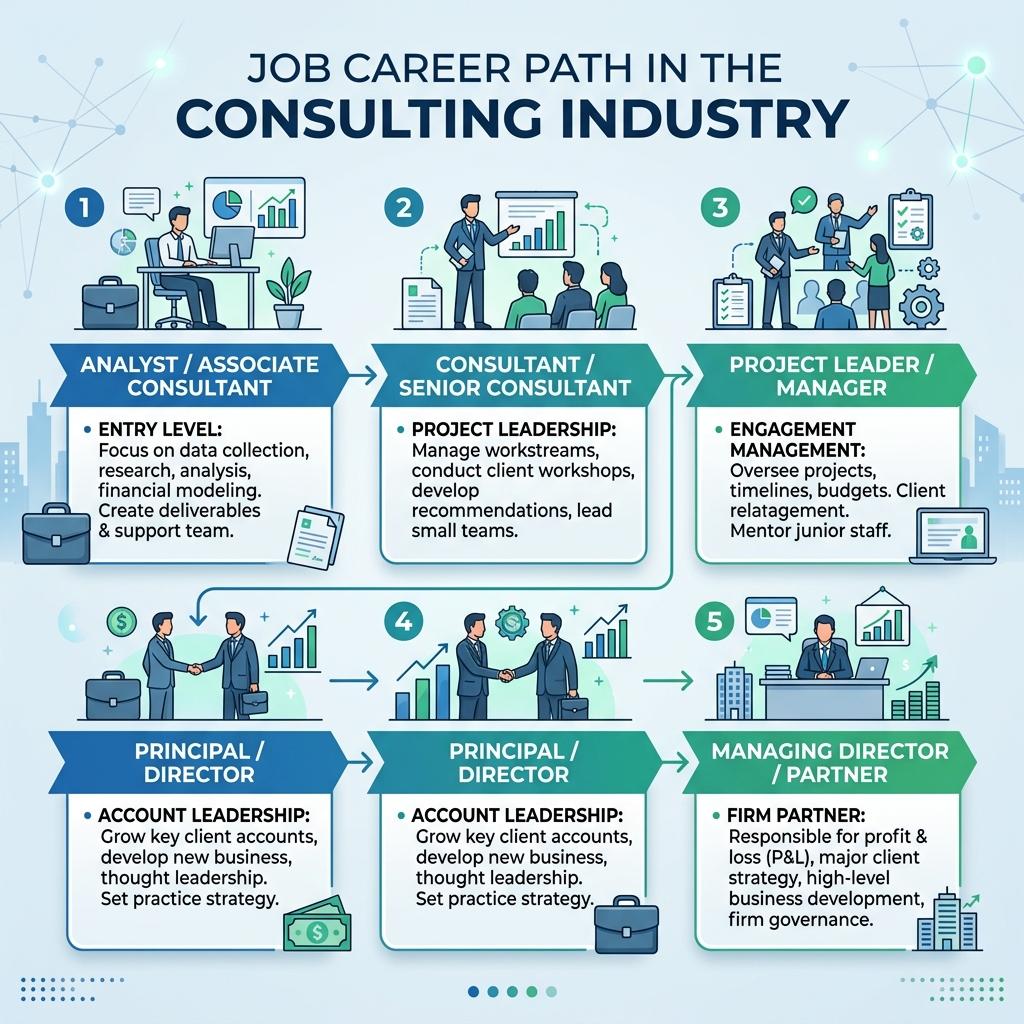
What is the typical career progression path in management consulting?
In most top-tier consulting firms, the career ladder follows a structured and predictable progression over 8 to 10 years:
- Analyst/Associate (0-2 years): Focuses on heavy research, data analysis, and creating presentation slides.
- Consultant/Senior Associate (2-4 years): Manages specific work streams, directs analysts, and handles daily client interactions.
- Project Leader/Engagement Manager (4-6 years): Leads the day-to-day project, manages the entire team, and acts as the primary client contact.
- Principal/Director (6-8 years): Oversees multiple projects simultaneously, focuses on client relationship management, and drives sales.
- Partner/Managing Director (8+ years): Owns equity in the firm, primarily responsible for generating revenue, pitching to new clients, and firm leadership.
What are the core skills required to succeed as a consultant?
To thrive in the consulting industry, professionals need a highly versatile blend of hard and soft skills:
- Problem-solving: The ability to break down complex, ambiguous business issues into logical, manageable parts.
- Analytical skills: Proficiency in Excel, SQL, and data modeling to derive actionable insights from massive datasets.
- Communication: Crafting compelling narratives, often using PowerPoint, to present complex findings simply to executives.
- Client management: Building trust, handling pushback, and maintaining professional relationships with stakeholders.
- Adaptability: Quickly learning entirely new industries and thriving in high-pressure, fast-paced environments.
How do the "Big Three" (MBB) firms compare to the "Big Four" consulting divisions?
While both groups are prestigious, they differ significantly in focus, lifestyle, and exit opportunities.
| Feature | MBB (McKinsey, BCG, Bain) | Big Four (Deloitte, PwC, EY, KPMG) |
|---|---|---|
| Primary Focus | Pure Strategy & C-Suite Advisory | Implementation, Operations, & Tech |
| Prestige & Selectivity | Extremely High | High |
| Working Hours | 60 - 80 hours/week | 50 - 60 hours/week |
| Exit Opportunities | Private Equity, VC, C-Suite | Corporate Management, Tech, Startups |
What is a case interview, and how should I prepare for it?
A case interview is a role-play exercise where candidates are asked to solve a real-world business problem. It tests your analytical reasoning, business acumen, and ability to think calmly under pressure.
To prepare effectively, you should follow a structured approach:
- Learn foundational frameworks (e.g., Profitability, Market Entry), but adapt them naturally rather than forcing them.
- Practice mental math to ensure quick, accurate calculations without a calculator.
- Conduct mock interviews with peers or industry mentors to simulate real interview pressure.
- Practice structuring your thoughts aloud so the interviewer can easily follow your logic.
What are the best exit opportunities after 2-3 years in consulting?
Consulting is renowned for offering exceptional exit opportunities due to the rigorous training and broad exposure consultants receive. Common exit paths include:
- Private Equity/Venture Capital: Leveraging financial modeling and due diligence skills to evaluate investments.
- Corporate Strategy: Joining Fortune 500 companies in internal strategy or operations leadership roles.
- Startups & Tech: Taking on Product Management, Chief of Staff, or Strategy & Operations (BizOps) roles.
- Graduate School: Many consultants leave to pursue a top-tier MBA, often fully sponsored by their consulting firm.
- Non-Profit/Public Sector: Applying corporate strategic frameworks to social impact organizations.
What is the typical compensation structure for an entry-level strategy consultant?
Compensation in top-tier strategy consulting is highly lucrative and structured across three main components. Below is a rough estimate for an entry-level analyst (undergraduate hire) in the US market:
| Compensation Component | Estimated Amount (USD) |
|---|---|
| Base Salary | $100,000 - $115,000 |
| Performance Bonus | $15,000 - $30,000 |
| Signing Bonus | $5,000 - $10,000 |
| Total First-Year Comp | $120,000 - $155,000 |
Note: Figures vary by firm, geographic location, and macroeconomic conditions.
Is an MBA strictly necessary to reach the Partner level in consulting?
Historically, earning an MBA from a top-tier business school was considered a mandatory stepping stone to reach the Partner level at major consulting firms. However, this is no longer strictly necessary.
Today, most top firms offer a "direct promote" path. If an Analyst consistently demonstrates high performance, strong leadership, and excellent client management skills, they can be promoted to the Consultant/Senior level without leaving for business school.
While an MBA remains incredibly valuable for building a network, pivoting from another industry, or taking a mental break, firms now equally value continuous on-the-job experience and deep subject matter expertise.
What are the main types of consulting specialties I can pursue?
The consulting industry is vast, offering several specializations tailored to different educational backgrounds and interests:
- Strategy Consulting: Advising C-level executives on high-level decisions like mergers, acquisitions, and market entry.
- Operations Consulting: Improving organizational efficiency, supply chain management, and day-to-day processes.
- IT/Technology Consulting: Implementing software, guiding digital transformation, and providing cybersecurity solutions.
- Financial Advisory: Assisting with corporate restructuring, risk management, and forensic accounting.
- Human Resources Consulting: Optimizing talent management, compensation structuring, and organizational design.
How important is networking when trying to break into the consulting industry?
Networking is absolutely critical in the consulting recruitment process. Because top firms receive thousands of resumes for just a handful of open spots, an internal referral can ensure your application is actually reviewed by a human.
Effective networking steps include:
- Attending campus recruiting events and firm info sessions to meet representatives directly.
- Conducting informational interviews with alumni from your university currently working at your target firms.
- Showcasing genuine curiosity and asking insightful questions about their specific project experiences.
A strong internal advocate can push your resume through the initial screening phase and straight into the interview pile.
What is the lifestyle and work-life balance really like in consulting?
The consulting lifestyle is famously demanding, though it varies significantly by firm, practice area, and project. Consultants typically work between 50 to 80 hours per week.
Historically, the industry followed a Monday-to-Thursday travel model, where consultants flew to the client site and returned home on Fridays. Post-pandemic, many firms have shifted to a hybrid model, reducing mandatory travel and allowing more remote work.
While the hours are long and the environment is high-pressure, the trade-offs include rapid career acceleration, high pay, and the accumulation of massive airline and hotel points. Most firms also enforce "protected weekends" to help prevent employee burnout.