 jobdayta.com
 Jobs and Career in Aviation Industry
Aviation encompasses the design, development, operation, and maintenance of aircraft, including airplanes, helicopters, and drones. It plays a critical role in global transportation, connecting cities and countries through commercial airlines and cargo services. Innovations in aerodynamics, propulsion systems, and avionics have significantly improved flight safety, efficiency, and sustainability. The aviation industry supports economic growth by enabling international trade, tourism, and military operations.
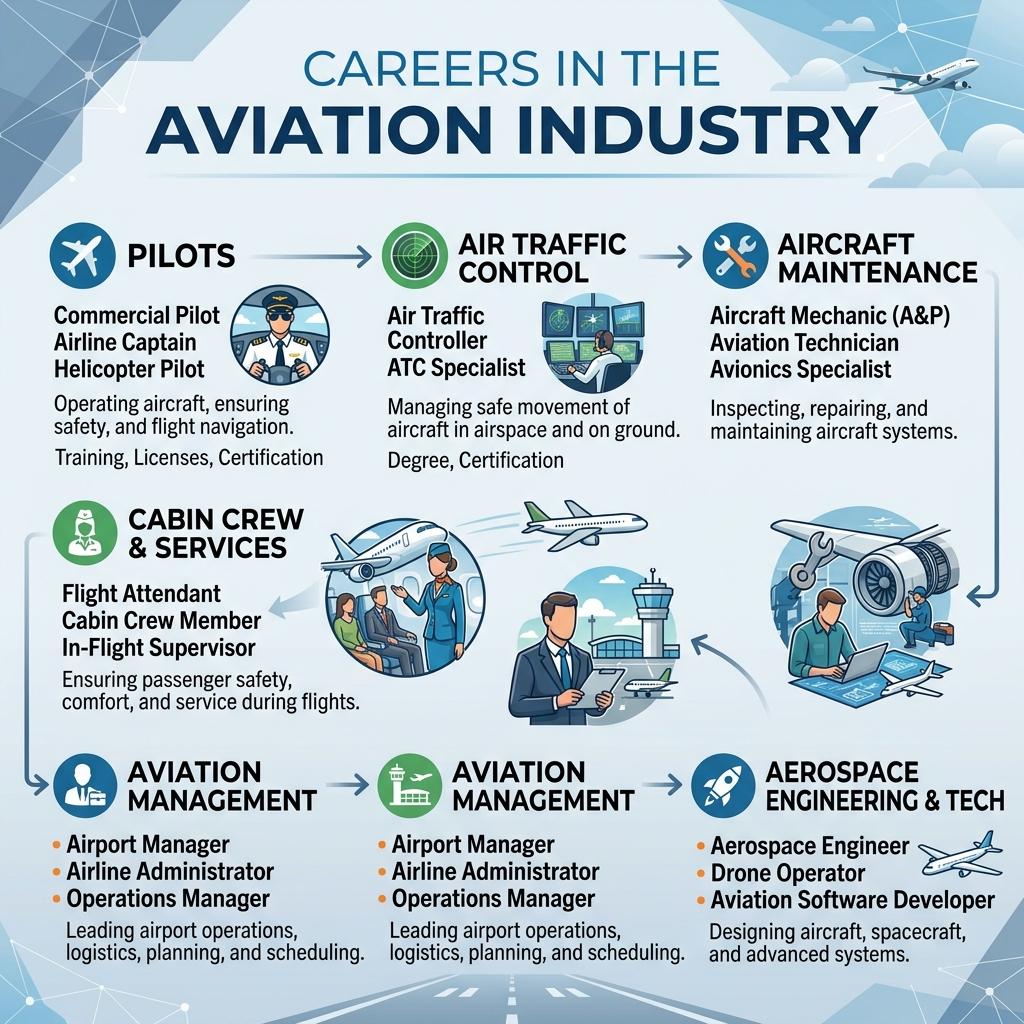
What are the main career sectors within the aviation industry?
The aviation industry offers diverse career paths that go far beyond just flying. The main sectors include:
- Flight Operations: Commercial pilots, flight attendants, and corporate pilots.
- Ground Operations: Air traffic controllers, aircraft dispatchers, and baggage handlers.
- Maintenance & Engineering: Aircraft mechanics (AMTs), avionics technicians, and aerospace engineers.
- Management & Administration: Airport managers, aviation safety inspectors, and airline corporate staff.
Each sector provides unique career development opportunities and requires specific certifications, training, or educational backgrounds.
What are the basic steps to become a commercial airline pilot?
Becoming a commercial pilot requires rigorous training and progressive certification. The typical career path includes:
- Obtaining a Private Pilot License (PPL).
- Earning an Instrument Rating (IR) to fly safely in various weather conditions.
- Acquiring a Commercial Pilot License (CPL).
- Gaining flight hours (usually a minimum of 1,500 hours) by working as a flight instructor, banner tower, or cargo pilot.
- Obtaining an Airline Transport Pilot (ATP) certificate.
Additionally, candidates must continuously pass strict medical examinations and background checks to maintain their career status.
What is the salary outlook for Aviation Maintenance Technicians (AMTs)?
Aviation Maintenance Technicians enjoy strong salary prospects due to a global shortage of skilled mechanics. Salaries vary based on experience, employer type, and geographic location.
| Experience Level | Estimated Annual Salary (USD) |
|---|---|
| Entry-Level | $45,000 - $55,000 |
| Mid-Level | $60,000 - $80,000 |
| Senior/Avionics Specialist | $85,000 - $110,000+ |
Mechanics working for major commercial airlines or specializing in complex avionics systems typically earn at the highest end of the pay scale.
Is becoming an Air Traffic Controller a good career, and what are the requirements?
Yes, being an Air Traffic Controller (ATC) is a highly rewarding and well-compensated career, though it can be high-stress. ATCs are responsible for the safe and orderly flow of global air traffic.
Basic requirements generally include:
- Being an authorized citizen/candidate under local aviation authorities (like the FAA).
- Completing an aviation degree or possessing relevant military/work experience.
- Passing rigorous pre-employment tests, including medical and psychological evaluations.
- Graduating from an official ATC training academy.
Because there is a mandatory retirement age (usually 56 in the US), there is a steady demand for new controllers.
How can a flight attendant advance their career in the aviation industry?
Flight attendants have several avenues for career progression. Advancement often relies on seniority, performance, and undertaking additional training.
- Lead Flight Attendant / Purser: Managing the cabin crew and passenger service on a specific flight.
- In-Flight Supervisor / Base Manager: Overseeing flight attendants at a specific airport base, handling schedules and employee performance.
- Safety/Service Instructor: Transitioning to the airline's training department to teach emergency procedures to new hires.
- Corporate Aviation: Moving from commercial airlines to private jets, which often offers higher pay and bespoke service opportunities.
Many also transition into corporate ground roles within HR or customer experience.
Are there opportunities in aviation for people without technical or flying backgrounds?
Absolutely. The aviation industry operates like a massive corporate ecosystem and heavily relies on non-technical professionals to keep airlines and airports running profitably.
Key non-technical career paths include:
- Human Resources: Recruiting, training, and managing employee relations.
- Marketing & Sales: Managing airline branding, loyalty programs, and corporate accounts.
- Finance: Handling aircraft leasing, fuel hedging, and corporate accounting.
- Customer Service: Overseeing gate agents, ticketing, and passenger relations.
Professionals with degrees in business, communications, or finance can find lucrative careers within airlines, airport authorities, and aerospace manufacturers.
Is a degree in Aviation Management worth it for career development?
A degree in Aviation Management is highly valuable for those looking to secure leadership roles within the industry. This degree bridges the gap between general business principles and the specific operational realities of aviation.
Graduates are well-positioned for roles such as:
- Airport Operations Manager
- Airline Station Manager
- Aviation Safety Consultant
While entry-level ground jobs may not require this specific degree, holding it significantly accelerates promotion into middle and upper management by providing essential knowledge on aviation law, airspace management, and industry economics.
What future technologies are shaping career development in aviation?
The aviation industry is rapidly modernizing, creating a high demand for tech-savvy professionals. Key technologies shaping future careers include:
- Sustainable Aviation: Engineers and scientists are needed to develop Sustainable Aviation Fuels (SAF) and hydrogen/electric aircraft.
- Artificial Intelligence (AI): AI is transforming flight routing, predictive maintenance, and dynamic pricing, requiring data scientists.
- Advanced Air Mobility (AAM): Electric VTOLs and drones are creating new job categories for remote pilots and airspace integration experts.
- Cybersecurity: As aircraft become connected flying networks, IT security experts are critical to protect against cyber threats.
Upskilling in these areas ensures excellent long-term career security.
What does an aerospace engineer do, and what are the education requirements?
Aerospace engineers design, test, and manufacture aircraft, spacecraft, and missiles. In the commercial aviation sector, they focus on improving fuel efficiency, structural integrity, and passenger safety.
Education and Career Requirements:
- A Bachelor’s degree in Aerospace or Mechanical Engineering is the minimum requirement.
- Coursework typically includes aerodynamics, propulsion, and thermodynamics.
- Many engineers pursue a Master’s degree to specialize in niche areas like avionics or advanced composite materials.
This career offers excellent growth potential, especially with the current push toward greener aviation technologies and the expansion of the commercial spaceflight sector.
What is the role of an Aircraft Dispatcher?
An Aircraft Dispatcher shares joint legal responsibility with the pilot-in-command for the safety and operational control of a flight. Often considered the "captain on the ground," they play a crucial behind-the-scenes role.
Their primary duties include:
- Planning flight paths based on weather patterns and airspace restrictions.
- Calculating precise fuel requirements and aircraft weight limits.
- Monitoring flight progress and communicating with the crew to reroute if emergencies or bad weather arise.
Becoming a dispatcher requires specialized training and an official Dispatcher Certificate. It is a highly respected, well-paying career with excellent long-term stability.