 jobdayta.com
 Jobs and Career in Trade Industry
Trade drives economic growth by facilitating the exchange of goods and services across borders, enhancing market efficiency and consumer choice. It enables countries to specialize in producing goods where they have a comparative advantage, boosting productivity and innovation. International trade agreements and policies shape the flow of exports and imports, impacting global supply chains and trade balances. Understanding trade dynamics is essential for businesses and policymakers aiming to capitalize on global opportunities and mitigate risks.
What are the most in-demand skilled trade jobs today?
The trade industry is currently experiencing a massive shortage of skilled workers, driving up demand and wages. Some of the fastest-growing and most lucrative trades include:
| Trade Profession | Industry Focus | Job Outlook |
|---|---|---|
| Electrician | Construction & Renewable Energy | High Growth |
| HVAC Technician | Climate Control & Refrigeration | High Growth |
| Plumber | Commercial & Residential Infrastructure | Steady Growth |
| Welder | Manufacturing & Infrastructure | High Growth |
How do I start a career in the skilled trades?
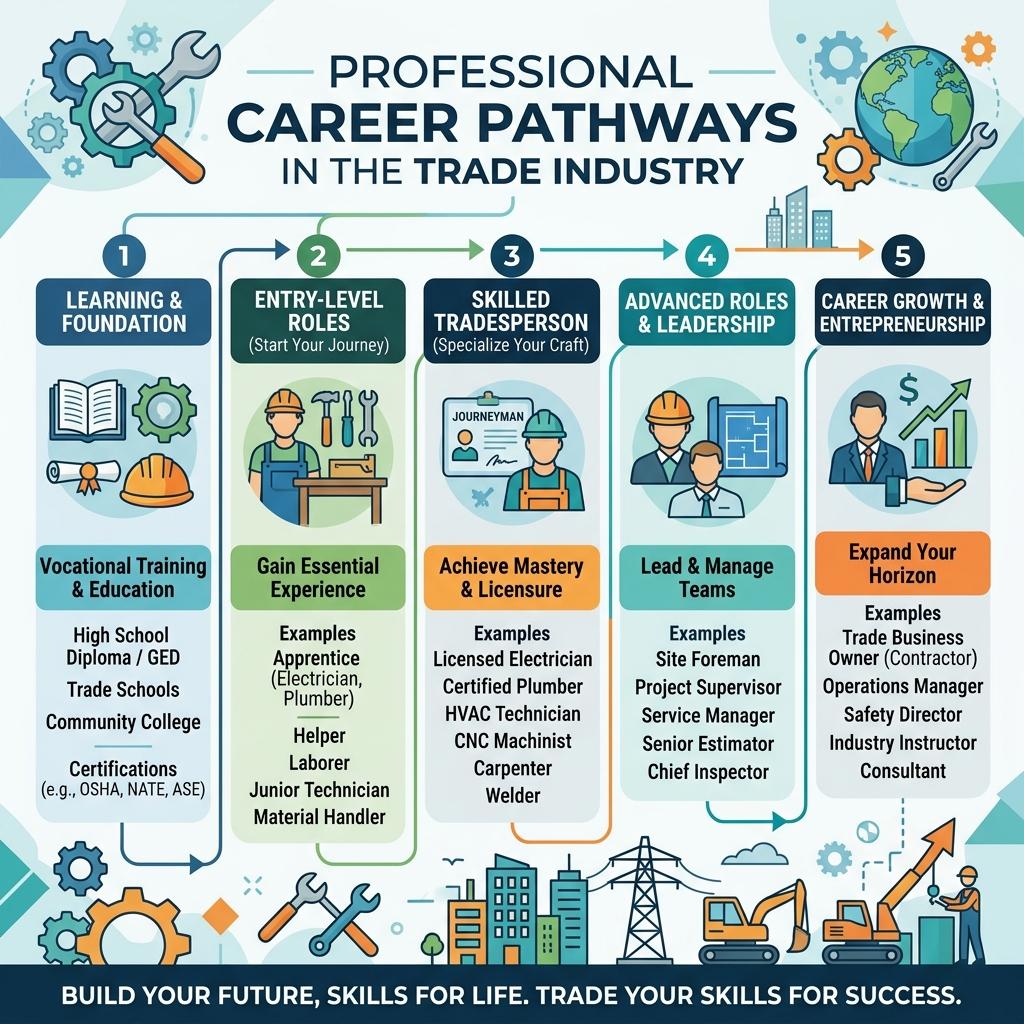
Starting a career in the trades is a structured process that combines education with hands-on training. Follow these typical steps:
- Earn a High School Diploma or GED: This is the minimum educational requirement.
- Attend a Vocational School (Optional): Complete a certificate program to learn foundational skills and theory.
- Secure an Apprenticeship: Apply through local unions or private companies to earn wages while learning on the job.
- Obtain Licensing: Pass your state or local licensing exams after completing the required apprenticeship hours.
What is the difference between a journeyman and a master tradesperson?
These titles represent different stages of career progression and expertise within the trade industry.
- Journeyman: A professional who has successfully completed their apprenticeship. They are fully licensed to work independently without direct supervision but generally cannot pull construction permits or own a contracting business.
- Master Tradesperson: The highest level of certification. To become a master, a journeyman must work a specific number of years, pass a rigorous advanced exam, and demonstrate extensive industry knowledge. Master tradespersons can supervise others, pull permits, and operate their own contracting businesses.
How does the financial investment of a trade career compare to a traditional college degree?
Entering the trade industry often presents a distinct financial advantage early in life compared to the traditional university route:
| Factor | Trade Career | 4-Year College Degree |
|---|---|---|
| Education Cost | $5,000 - $15,000 (often paid via apprenticeship) | $40,000 - $150,000+ |
| Time to Income | Immediate (earn while you learn) | 4 to 6 years |
| Student Debt | Minimal to none | Historically high |
How can a tradesperson advance their career into management?
Career development in the trades isn't limited to using tools; there is a clear pathway to leadership and management. A typical progression includes:
- Foreman: Managing a crew on a specific job site and ensuring daily tasks are completed safely.
- Project Manager: Overseeing entire construction projects, including budgets, timelines, and material procurement.
- Estimator: Analyzing blueprints and determining the costs of labor, materials, and time required for a bid.
- Business Owner: Utilizing master-level licenses to open an independent contracting company.
Are there growing opportunities for women in the skilled trades?
Yes, opportunities for women in the trades are expanding rapidly. Historically a male-dominated field, the industry is actively recruiting women to combat the skilled labor shortage.
- Equal Pay: The gender pay gap in construction is significantly smaller than the national average, with women earning roughly 95% of what men make.
- Support Networks: Organizations like Tradeswomen, Inc. and the National Association of Women in Construction (NAWIC) provide mentorship and networking.
- High Demand: Companies are actively diversifying their workforce, offering scholarships and specialized pre-apprenticeship programs for women.
What soft skills are essential for success in the trade industry?
While technical prowess is required, career advancement relies heavily on soft skills. Employers look for the following traits:
- Problem Solving: The ability to troubleshoot unexpected issues on a job site safely and efficiently.
- Communication: Clearly explaining complex mechanical issues to clients and coordinating with other contractors.
- Time Management: Completing tasks within strict project deadlines to keep the overall build on schedule.
- Adaptability: Adjusting to changing weather conditions, material shortages, or updated building codes.
Do trade jobs offer good job security?
The trade industry offers excellent long-term job security for several reasons. First, trades are highly resistant to automation and artificial intelligence; a robot cannot easily navigate the complex, unpredictable environment of a residential plumbing emergency or electrical retrofit.
Furthermore, society relies heavily on infrastructure. Buildings will always need electricity, climate control, and water systems. As the current workforce ages and retires, the gap in skilled labor continues to widen, ensuring that skilled tradespeople will remain in high demand for decades to come.
What are the typical licensing and continuing education requirements?
Maintaining a career in the trades requires ongoing commitment to safety and regulatory standards. While requirements vary by state and trade, the general process includes:
- Initial Examination: Passing a state board exam covering technical knowledge, safety codes, and business law.
- License Renewal: Paying a renewal fee every 1 to 3 years to maintain active status.
- Continuing Education Units (CEUs): Completing a mandated number of classroom hours annually to stay updated on the latest building codes, safety protocols, and green energy standards.
How is modern technology impacting trade industry jobs?
Technology is rapidly transforming how tradespeople work, making jobs safer, more precise, and highly efficient. Rather than replacing workers, these tools enhance their capabilities.
- Building Information Modeling (BIM): Electricians and plumbers use 3D modeling software to map out complex systems before construction begins, reducing errors.
- Drones: Roofers and inspectors use drones to survey hazardous areas without risking a fall.
- Smart Tools: Modern power tools track performance data, battery health, and location via Bluetooth.
- Green Tech: HVAC technicians and electricians are learning to install solar panels, EV charging stations, and smart home climate systems.