 jobdayta.com
 Jobs and Career in Telecommunication Industry
Telecommunication involves the transmission of information over significant distances through electronic means. It encompasses technologies such as telephone networks, optical fiber communication, satellite systems, and wireless networks including 4G and 5G. The sector enables global connectivity, supporting internet access, voice calls, and data exchange critical for business, government, and personal communication. Advancements in telecommunication infrastructure drive innovation in IoT, remote work, and digital services worldwide.
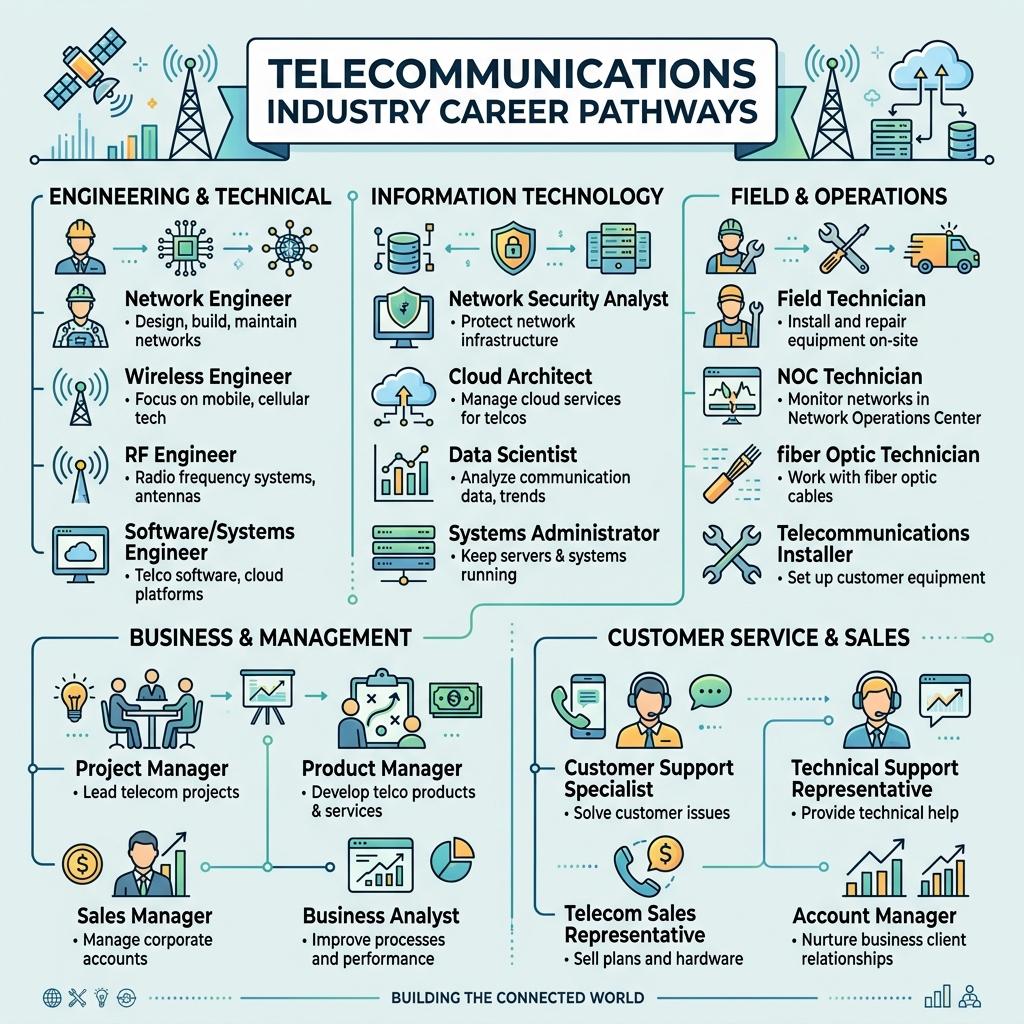
What are the core job categories in the telecommunications industry?
The telecom industry encompasses a diverse range of roles, broadly categorized into technical, customer-facing, and operational fields:
- Engineering & Technical: Network engineers, RF (Radio Frequency) engineers, and field technicians who design, build, and maintain infrastructure.
- IT & Cybersecurity: Software developers and security analysts responsible for protecting data and managing cloud-based networks.
- Sales & Customer Support: Account executives and customer service representatives driving revenue and assisting end-users.
- Operations & Management: Project managers and regulatory compliance officers ensuring smooth, legal business operations.
What educational background is typically required for a Telecom Engineer?
A career as a Telecom Engineer generally requires a solid foundation in STEM. The typical educational requirements include:
- Bachelor's Degree: Most employers require a B.S. in Electrical Engineering, Telecommunications, Computer Science, or Information Technology.
- Master's Degree (Optional): For advanced roles in research or network architecture, an M.S. in specialized fields like Wireless Communications is highly beneficial.
- Hands-on Training: Practical experience through internships or university lab work with routing, switching, and signal processing is crucial for early career success.
How is the transition to 5G impacting career opportunities in telecom?
The global rollout of 5G technology is massively expanding career opportunities. 5G requires entirely new infrastructure, creating high demand for RF Engineers, Cell Site Technicians, and Fiber Optic Splicers.
Beyond physical infrastructure, 5G's low latency enables IoT (Internet of Things) and edge computing. This shift has generated a surge in demand for Software Engineers, Cloud Architects, and Data Scientists who can develop and manage complex applications. Consequently, traditional hardware-centric professionals are upskilling in software-defined networking (SDN) to stay relevant.
What are the essential soft skills needed for a successful career in telecom?
While technical skills are vital, soft skills are equally crucial for career advancement in telecommunications:
- Communication:
- Technical Translation: The ability to explain complex network issues to non-technical stakeholders and clients.
- Problem-Solving:
- Analytical Thinking: Rapidly diagnosing and resolving network outages under high-pressure scenarios.
- Adaptability:
- Continuous Learning: Maintaining the flexibility to keep pace with rapidly evolving technologies like 5G, IoT, and AI.
What is the typical career progression for a Network Architect?
Becoming a Network Architect is a senior-level milestone. The typical career trajectory proceeds as follows:
- Entry-Level (1-3 years): Network Administrator or IT Support Specialist. Focuses on daily monitoring and basic troubleshooting.
- Mid-Level (3-7 years): Network Engineer. Responsible for implementing network designs, configuring routers/switches, and managing firewalls.
- Senior-Level (7-10 years): Senior Network Engineer. Handles complex technical escalations and leads infrastructure upgrade projects.
- Advanced (10+ years): Network Architect. Shifts from daily implementation to high-level design, planning enterprise-wide network strategies and cloud integrations.
How does a role in Telecom Sales differ from traditional tech sales?
Telecom sales requires a unique understanding of physical infrastructure and regulatory environments compared to general software sales.
| Feature | Telecom Sales | Software/Tech Sales |
|---|---|---|
| Product Focus | Bandwidth, fiber infrastructure, VoIP, 5G enterprise solutions. | SaaS platforms, software licenses, IT hardware. |
| Sales Cycle | Often longer due to physical installation and infrastructure checks. | Can be shorter; often deployed instantly via the cloud. |
| Regulation | Highly regulated (FCC compliance, local zoning for hardware). | Less geographically regulated; focused heavily on data privacy. |
What are the emerging job roles in the telecom sector due to AI and automation?
Artificial Intelligence and automation are transforming how telecom companies manage their networks, leading to exciting new job roles:
- AI Network Automation Engineer: Develops algorithms that allow networks to self-optimize, predict outages, and automatically reroute traffic without human intervention.
- Telecom Data Scientist: Analyzes massive amounts of consumer and network data to improve customer retention, personalize marketing, and optimize cell tower placement.
- CX Automation Manager: Designs and oversees AI-driven chatbots and virtual assistants that handle Tier 1 customer support inquiries, improving response efficiency.
What certifications are highly valued for telecom networking professionals?
To stand out in the telecom networking sector, industry-recognized certifications are highly recommended to validate your skills:
- Cisco Certified Network Associate (CCNA) & Professional (CCNP): The gold standards for foundational and advanced routing and switching knowledge.
- CompTIA Network+: An excellent vendor-neutral, entry-level certification.
- Certified Telecommunications Network Specialist (CTNS): Validates broad knowledge of broadband, wireless, and core telecom technologies.
- AWS Certified Advanced Networking: Increasingly critical as telecom operators migrate core network functions to the public cloud.
What is the average salary range for common telecom roles?
Salaries in the telecom industry vary based on technical expertise, geographic location, and experience. Below is a general estimate of annual salaries in the US market:
| Job Title | Entry-Level Salary | Senior-Level Salary |
|---|---|---|
| Equipment Installer | $40,000 | $70,000+ |
| Telecom Engineer | $70,000 | $120,000+ |
| RF Engineer | $75,000 | $135,000+ |
| Network Architect | $110,000 | $170,000+ |
How can professionals stay updated with rapid technological changes in telecom?
The telecom sector evolves at a breakneck pace. To avoid skill stagnation, professionals should adopt continuous learning strategies:
- Industry Publications: Regularly read specialized news sources like FierceTelecom, RCR Wireless News, and SDxCentral.
- Professional Associations: Join organizations like the IEEE Communications Society (ComSoc) to access peer-reviewed journals and networking conferences.
- Vendor Training: Participate in free and paid training modules offered by major telecom vendors like Ericsson, Nokia, and Cisco to learn about proprietary hardware advancements.