 jobdayta.com
 Jobs and Career in Biotechnology Industry
Biotechnology harnesses biological processes and organisms to develop innovative products and technologies across healthcare, agriculture, and environmental sectors. It integrates genetic engineering, molecular biology, and bioinformatics to enhance disease treatment, improve crop yields, and create sustainable biofuels. Advanced techniques like CRISPR gene editing accelerate genetic modifications for precision medicine and improved agricultural traits. This interdisciplinary field drives groundbreaking solutions for global challenges in medicine, food security, and environmental conservation.
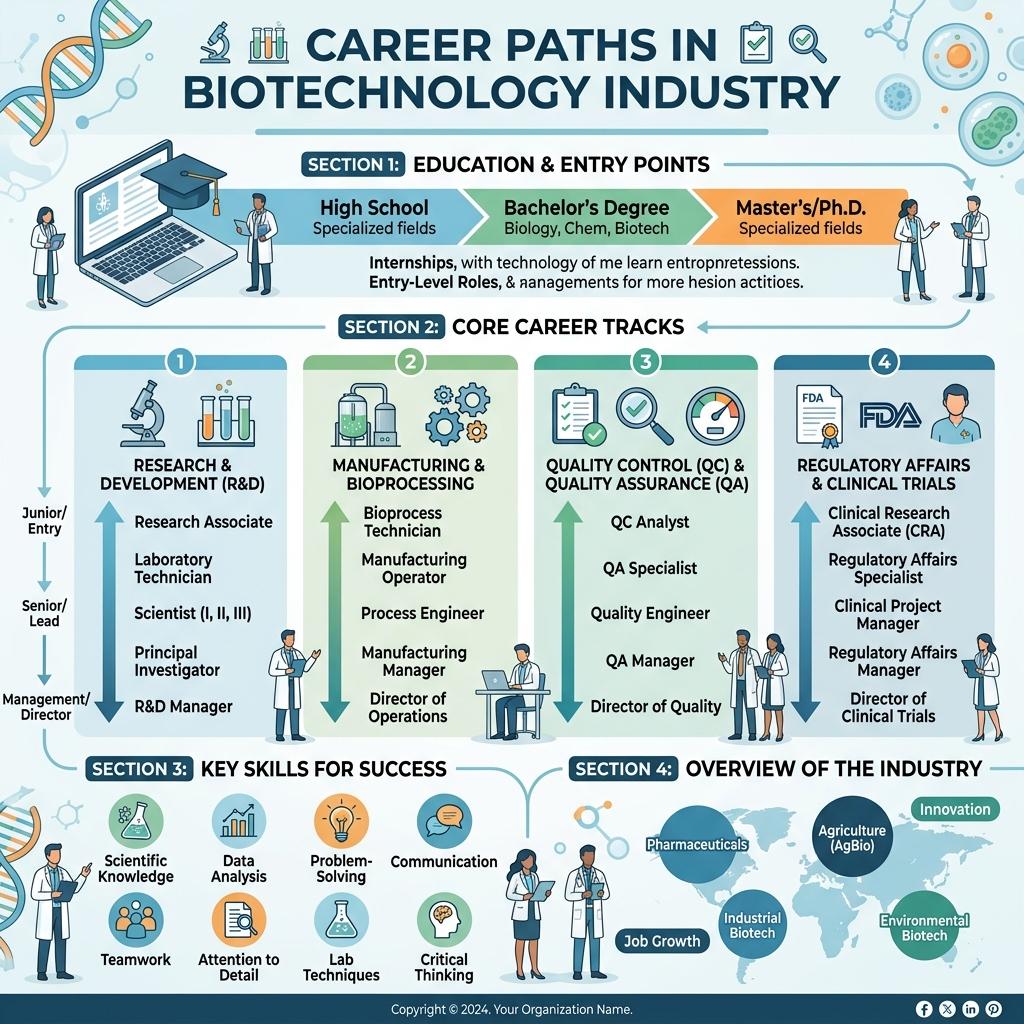
What are the primary career paths available in the biotechnology industry?
The biotechnology industry offers diverse career opportunities that generally fall into four primary paths:
- Research & Development (R&D): Focuses on drug discovery, genomics, and product innovation. Roles include Research Associate, Scientist, and Bioinformatics Analyst.
- Clinical Research & Medical Affairs: Manages human trials and acts as a bridge between the company and healthcare professionals. Roles include Clinical Trial Manager and Medical Science Liaison (MSL).
- Manufacturing & Quality Control: Ensures products are produced safely and consistently. Roles include Bioprocessing Engineer, Quality Assurance (QA) Manager, and Quality Control (QC) Analyst.
- Commercial & Business: Handles the market strategy, sales, and intellectual property. Roles include Product Manager, Regulatory Affairs Specialist, and Biotech Sales Rep.
What educational background is required for a career in biotech?
Educational requirements vary significantly depending on the specific role and career trajectory:
- Bachelor’s Degree (B.S.): Sufficient for entry-level roles such as laboratory technician, research assistant, or quality control analyst. Majors in biology, chemistry, or bioengineering are preferred.
- Master’s Degree (M.S.): Ideal for mid-level research roles, project management, and specialized fields like bioinformatics or regulatory affairs. It accelerates career progression faster than a B.S. alone.
- Doctorate (Ph.D. or Pharm.D.): Required for advanced R&D positions, Principal Scientist roles, Medical Science Liaisons, and leading academic or industry research teams.
Business roles (like product management) often require an MBA combined with a scientific undergraduate degree.
What are the highest-paying roles in the biotechnology sector?
Compensation in biotech is highly competitive, especially for roles requiring advanced degrees or specialized expertise. Below is a breakdown of some of the highest-paying positions:
| Job Title | Estimated Average Salary (USD) | Primary Focus |
|---|---|---|
| Chief Medical Officer (CMO) | $250,000 - $400,000+ | Clinical trials and regulatory strategy |
| Biotech CEO / Founder | $200,000 - $500,000+ | Overall business strategy and fundraising |
| Principal Scientist | $130,000 - $180,000 | Leading R&D projects and lab teams |
| Medical Science Liaison | $140,000 - $190,000 | Scientific communication with doctors |
How can someone transition from academia to an industry role?
Transitioning from an academic lab to a corporate biotechnology role requires a shift in mindset and strategic networking. Follow these steps:
- Identify Transferable Skills: Highlight project management, data analysis, troubleshooting, and specific assay techniques rather than just academic publications.
- Tailor Your Resume: Convert your academic CV into an industry-focused resume (1-2 pages). Emphasize measurable outcomes, teamwork, and technical proficiencies.
- Network Relentlessly: Attend industry conferences, join associations like BIO or local biotech hubs, and utilize LinkedIn to connect with industry insiders.
- Understand the Business: Familiarize yourself with industry timelines, regulatory guidelines (like FDA phases), and the concept of return on investment (ROI).
What soft skills are essential for career advancement in biotech?
While technical expertise gets you hired, soft skills are what get you promoted in the biotechnology industry. Essential soft skills include:
- Communication: The ability to translate complex scientific data into clear, actionable insights for non-scientific stakeholders (investors, marketing, executives).
- Cross-functional Teamwork: Biotech products require collaboration between R&D, manufacturing, QA, and regulatory teams. Playing well with others is non-negotiable.
- Adaptability: Scientific projects often pivot rapidly due to failed experiments or changing market conditions. Flexibility is crucial.
- Time Management: Industry moves much faster than academia. Meeting strict commercial and regulatory deadlines is expected.
Are there non-laboratory jobs available in biotechnology?
Absolutely. The biotech industry relies heavily on professionals outside the laboratory to bring life-saving products to market. Prominent non-lab roles include:
- Regulatory Affairs: Ensures products comply with strict government regulations (FDA, EMA) during development and commercialization.
- Bioinformatics & Data Science: Involves analyzing massive biological datasets (like genomic sequencing) using computational tools.
- Business Development: Focuses on securing partnerships, licensing technologies, and managing mergers and acquisitions.
- Technical Writing: Involves drafting clinical trial reports, standard operating procedures (SOPs), and user manuals for complex biotech equipment.
What is the typical career progression for a Research Associate?
A Research Associate (RA) role is a common entry point for B.S. and M.S. graduates. The typical career ladder in an industry lab looks like this:
- Research Associate I: Entry-level. Focuses on executing experiments, maintaining lab equipment, and basic data entry under strict supervision.
- Research Associate II / III: Mid-level. Handles more complex assays, troubleshoots protocols, and begins analyzing data independently.
- Senior Research Associate (SRA): Leads specific experiments, trains junior staff, and contributes to experimental design.
- Associate Scientist / Scientist: Often requires a Ph.D., but a highly experienced SRA can break into this tier. Focuses on project leadership and high-level R&D strategy.
How important are certifications and continuous learning in biotech?
Continuous learning is critical in biotechnology because scientific knowledge and technologies evolve at a breakneck pace. Professionals who do not update their skills risk career stagnation.
Certifications can provide a massive competitive edge, especially in heavily regulated or management-heavy areas. For example, obtaining a Regulatory Affairs Certification (RAC) is highly prized for regulatory professionals. Similarly, a Project Management Professional (PMP) certification is incredibly valuable for clinical trial managers and operations directors. Taking short courses on emerging tools, like CRISPR gene editing or Python for data science, also significantly boosts employability.
What are the emerging job trends in the biotech industry?
The biotechnology landscape is rapidly shifting, creating new job categories and increasing demand for hybrid skill sets. Key emerging trends include:
- Artificial Intelligence (AI) in Drug Discovery: There is a massive demand for professionals who understand both machine learning and molecular biology to speed up drug screening.
- Cell and Gene Therapies: As treatments like CAR-T become more common, there is a surge in demand for specialized biomanufacturing engineers and viral vector experts.
- Personalized Medicine: Growth in targeted therapies has created a need for genetic counselors and biomarker development scientists.
What strategies can help a candidate stand out during a biotech job interview?
To differentiate yourself in a competitive biotech interview, you must prove that you understand both the science and the business context. Use these strategies:
- Research the Pipeline: Read up on the company's clinical pipeline, recent press releases, and flagship products. Mention these during the interview.
- Use the STAR Method: Answer behavioral questions by outlining the Situation, Task, Action, and Result. Focus heavily on the concrete "Results" of your past lab work or projects.
- Showcase Regulatory Awareness: Even if applying for an R&D role, showing a basic understanding of Good Laboratory Practices (GLP) or FDA guidelines demonstrates industry readiness.
- Prepare Insightful Questions: Ask about the company's timeline for next clinical milestones or how cross-functional teams collaborate.