 jobdayta.com
 Jobs and Career in Chemical Industry
Chemicals are substances with distinct molecular compositions used in various industries, including pharmaceuticals, agriculture, and manufacturing. Their properties and reactions enable the creation of products such as plastics, detergents, and fertilizers. Advanced chemical processes drive innovation in energy storage, environmental protection, and material science. Understanding chemical interactions is essential for developing sustainable solutions and improving human health.
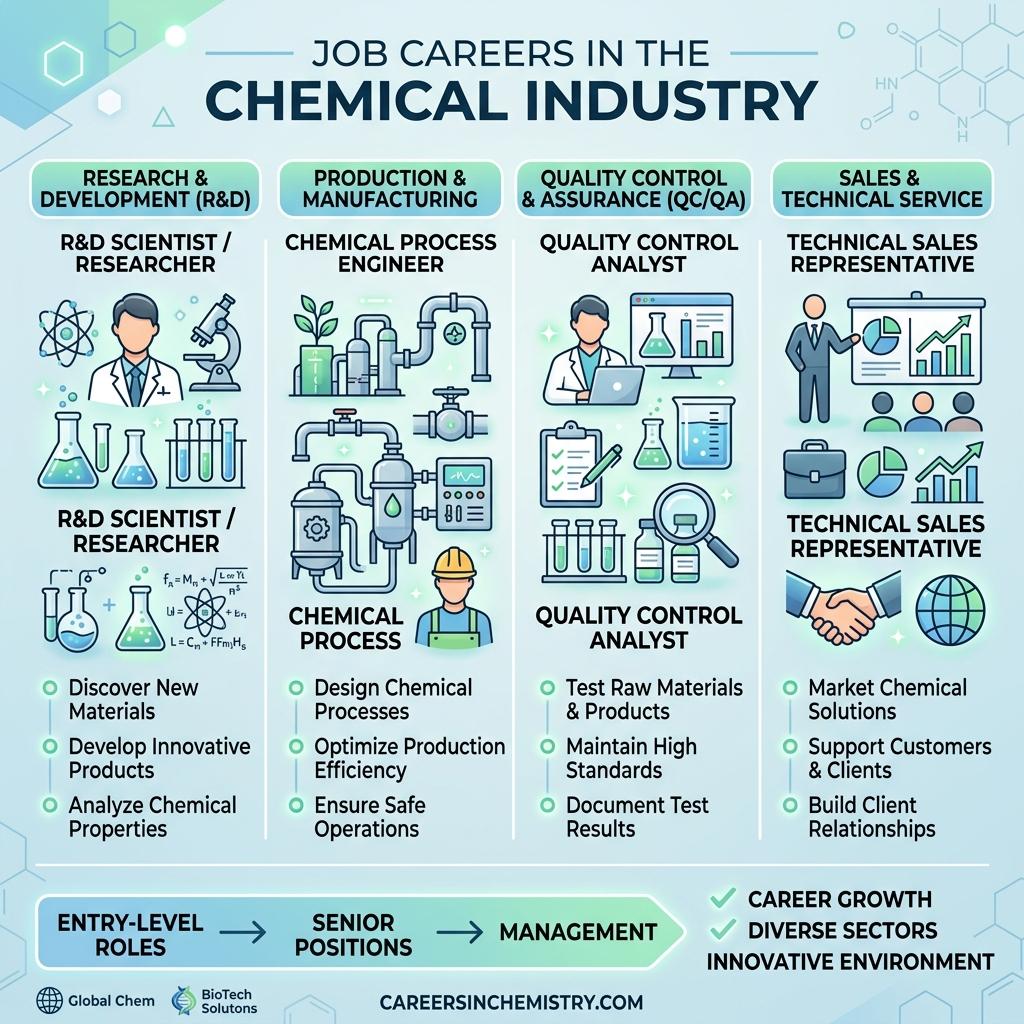
What are the primary career paths in the chemical industry?
The chemical industry offers diverse career trajectories tailored to different skill sets and educational backgrounds:
- Research & Development (R&D): Focused on synthesizing new compounds, developing innovative materials, and improving product formulations.
- Process Engineering/Manufacturing: Dedicated to scaling up lab-scale recipes to industrial production levels safely, economically, and efficiently.
- Quality Assurance/Quality Control (QA/QC): Ensuring raw materials and finished products meet strict regulatory and safety standards using analytical testing.
- Sales and Technical Support: Bridging the gap between complex chemical products and commercial clients by translating technical specs into business solutions.
What is the typical salary range for chemical industry professionals?
Salaries in the chemical sector vary widely based on education, geographic location, and specific job roles. Below is an estimated breakdown of median annual salaries in the US:
| Job Title | Entry-Level | Mid-to-Senior Level |
|---|---|---|
| Lab Technician | $40,000 - $50,000 | $60,000+ |
| Analytical Chemist | $55,000 - $65,000 | $85,000+ |
| Chemical Engineer | $75,000 - $85,000 | $130,000+ |
| R&D Scientist (Ph.D.) | $90,000 - $105,000 | $150,000+ |
How important is a Master's degree or Ph.D. for career advancement?
Advanced degrees can significantly dictate your career ceiling, depending on your chosen department:
- Bachelor’s Degree: Ideal for entering QA/QC, process engineering, or technical sales. Career growth into plant management is highly possible without further degrees.
- Master’s Degree: Provides specialized knowledge, often accelerating promotion to senior engineering or laboratory management roles.
- Ph.D.: Generally considered essential for high-level Research & Development (R&D) positions, principal scientist roles, and leading major innovation projects.
While a Ph.D. drives innovation careers, practical experience and certifications hold equal or greater weight in manufacturing and operations.
What are the top skills required to succeed as a process chemist?
A process chemist must seamlessly bridge the gap between small-scale lab synthesis and large-scale plant manufacturing. Essential skills include:
- Technical Competency:
- Deep understanding of organic synthesis, kinetics, and thermodynamics.
- Familiarity with analytical techniques (HPLC, GC-MS).
- Safety and Regulatory Knowledge: Mastery of OSHA standards, hazardous waste management, and process safety protocols.
- Problem Solving: The ability to troubleshoot yield drops, heat transfer issues, or purity problems during scale-up.
- Collaboration: Effectively communicating with chemical engineers, plant operators, and QA/QC teams to ensure smooth production.
Which sub-sectors of the chemical industry are experiencing the fastest job growth?
As global priorities shift towards sustainability and advanced technologies, several sub-sectors are seeing rapid employment growth:
- Green Chemicals and Bioplastics: Driven by consumer and regulatory demand to replace fossil-fuel-based plastics with biodegradable alternatives.
- Agrochemicals: Focusing on high-yield, environmentally friendly fertilizers and targeted pesticides to feed a growing global population.
- Battery Materials: Surging demand for lithium-ion and solid-state battery chemicals due to the electric vehicle (EV) boom.
- Specialty Materials: Developing lightweight polymers and resins for aerospace, 3D printing, and semiconductor manufacturing.
How can someone transition from a laboratory role to a management position?
Transitioning from the bench to management requires shifting focus from individual technical tasks to team productivity and business strategy. Follow these steps:
- Master the Technical Basics: Establish yourself as a reliable, highly competent chemist.
- Take on Leadership Duties: Volunteer to train new hires, lead safety committees, or manage equipment maintenance and vendor relations.
- Develop Soft Skills: Cultivate conflict resolution, communication, and cross-departmental collaboration abilities.
- Understand the Business: Learn how lab operations impact the company's bottom line, including supply chain dynamics and budget metrics.
- Pursue Further Education: Consider earning a project management certification (PMP) or an MBA.
What role does sustainability play in modern chemical careers?
Sustainability is radically transforming career profiles in the chemical industry. It is no longer a niche concept but a core business strategy driven by Environmental, Social, and Governance (ESG) criteria.
Professionals are now expected to implement the Twelve Principles of Green Chemistry into their daily work. This includes designing safer chemicals, improving energy efficiency, and minimizing toxic waste. New career paths, such as "Life Cycle Analyst" and "Sustainability Director," have emerged entirely focused on reducing corporate carbon footprints. Demonstrating knowledge of circular economy principles is a major competitive advantage for job seekers.
What are the typical work environments for chemical professionals?
Work environments vary drastically depending on the specific phase of chemical production. Here is a comparison:
| Environment | Typical Roles | Key Characteristics |
|---|---|---|
| Laboratory | R&D Chemists, QA/QC Analysts | Climate-controlled, highly sterile, focused on bench-scale experiments, fume hoods, and analytical testing. |
| Manufacturing Plant | Process Engineers, Operators | Fast-paced, noisy, requires strict PPE (hard hats, steel-toe boots), focused on large-scale production reactors. |
| Corporate Office | Sales Managers, Regulatory Affairs | Standard office setting, focused on client meetings, compliance documentation, and strategic planning. |
Are professional certifications necessary for career development in chemistry?
While academic degrees are the primary qualification, professional certifications can significantly boost employability, demonstrate specialized expertise, and increase salary potential. Key certifications include:
- Six Sigma (Green/Black Belt): Highly valued in manufacturing and process engineering for reducing product defects and optimizing production efficiency.
- HAZWOPER: Essential for professionals handling hazardous materials, waste management, or involved in environmental cleanup.
- Professional Engineer (PE): Crucial for chemical engineers who sign off on plant designs or offer consulting services to the public.
- Regulatory Certifications: Courses in FDA/cGMP compliance are vital for chemists working in the pharmaceutical, cosmetic, or food chemistry sectors.
What are the biggest challenges facing early-career professionals in the chemical industry today?
Early-career professionals are entering a rapidly evolving industry and must navigate several modern challenges:
- Technological Disruption: Artificial Intelligence (AI) and laboratory automation are changing how R&D is conducted. Young chemists must learn to integrate data science and machine learning into their physical research.
- Regulatory Complexity: Navigating increasingly strict global environmental and safety regulations (such as REACH in Europe or updated EPA rules) requires a steep learning curve.
- Shift to Green Technologies: Transitioning away from traditional petrochemicals means learning entirely new processes related to biopolymers and renewable feedstocks.
Adapting through continuous learning is crucial for overcoming these hurdles.