 jobdayta.com
 Jobs and Career in Marketing Industry
Marketing encompasses strategic activities designed to identify, attract, and retain customers by delivering value through targeted promotions and market research. It involves analyzing consumer behavior, competitive dynamics, and market trends to develop compelling campaigns that drive brand awareness and sales growth. Digital marketing leverages SEO, social media platforms, and data analytics to optimize outreach and engagement. Effective marketing integrates product positioning, pricing strategies, and customer relationship management to maximize return on investment.
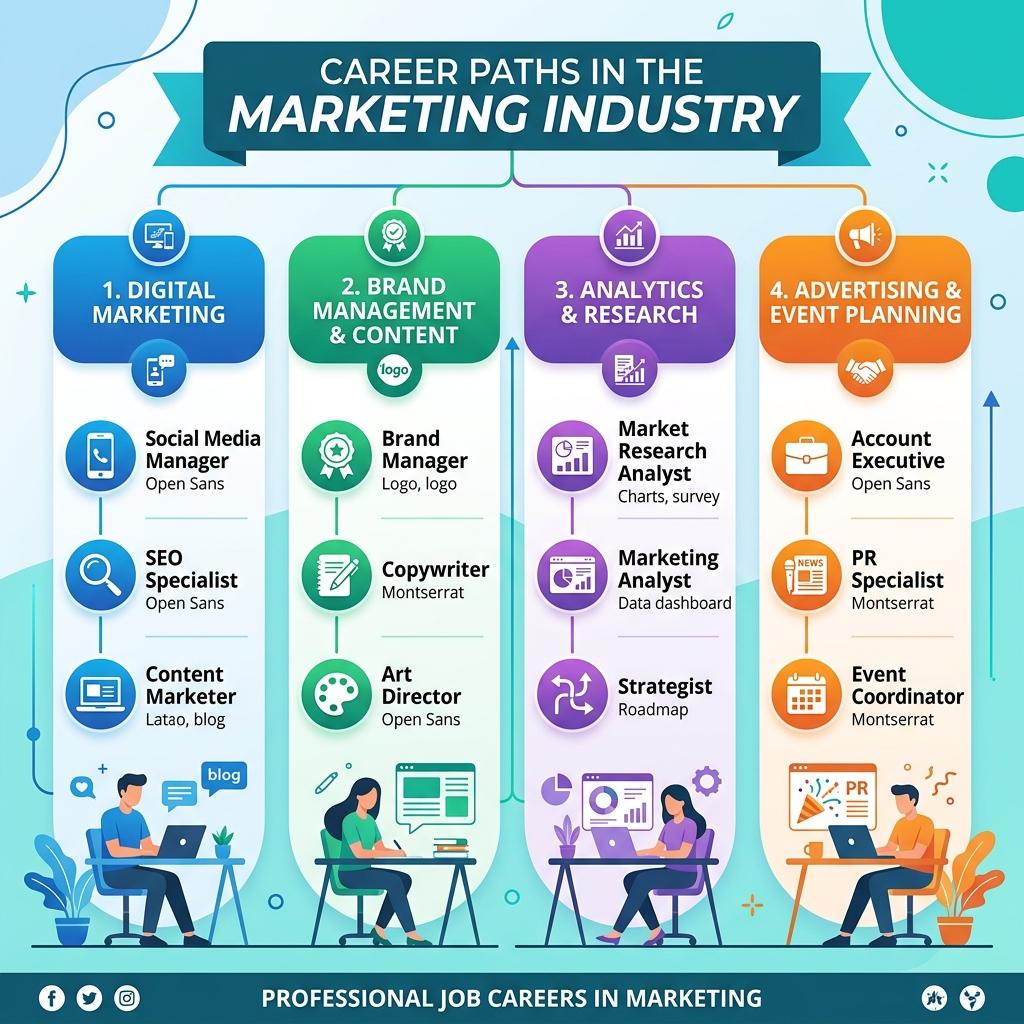
What are the most common entry-level roles in marketing?
Entering the marketing industry usually starts with roles focused on execution and learning core concepts. Common entry-level positions include:
- Marketing Coordinator: Assists with campaign execution, administrative tasks, and market research.
- Social Media Assistant: Manages daily postings, community engagement, and tracks basic social metrics.
- Content Writer: Creates blog posts, email copy, and website content to drive organic traffic.
- SEO/SEM Specialist: Focuses on keyword research, optimizing web pages, and assisting with paid search campaigns.
These roles provide a solid foundation for understanding audience behavior and campaign analytics, acting as a stepping stone for career development.
What is the typical career progression for a digital marketer?
A digital marketing career typically follows a clear vertical trajectory, moving from execution to strategic leadership:
- Entry-Level (0-2 years): Digital Marketing Coordinator or Assistant.
- Mid-Level (2-5 years): Digital Marketing Specialist or Strategist (e.g., SEO Specialist, Email Marketer).
- Management (5-8 years): Digital Marketing Manager. Focuses on budget allocation, team management, and cross-channel strategy.
- Leadership (8-12 years): Director of Marketing or VP of Marketing. Oversees entire marketing departments and aligns marketing with company goals.
- Executive (12+ years): Chief Marketing Officer (CMO). Drives global brand vision and overall business growth.
How do average salaries compare across different marketing roles?
Marketing salaries vary widely based on experience, location, and specialization. Below is a general overview of average annual salaries in the US:
| Marketing Role | Average Annual Salary (USD) |
|---|---|
| Social Media Coordinator | $45,000 - $55,000 |
| SEO Specialist | $55,000 - $70,000 |
| Marketing Manager | $80,000 - $110,000 |
| Product Marketing Manager | $100,000 - $140,000 |
| Chief Marketing Officer (CMO) | $170,000+ |
What hard and soft skills are essential for career development in marketing?
To advance in marketing, professionals need a blend of technical expertise and interpersonal abilities.
- Hard Skills:
- Data Analysis (Google Analytics, Excel, SQL)
- Search Engine Optimization (SEO) & Marketing (SEM)
- Copywriting and Content Management Systems (CMS)
- CRM Management (Salesforce, HubSpot)
- Soft Skills:
- Creativity: Developing unique campaign ideas that capture audience attention.
- Adaptability: Keeping up with rapidly changing digital trends and search algorithms.
- Communication: Effectively presenting ideas to stakeholders and writing compelling messaging.
What is the difference between B2B and B2C marketing careers?
Marketing careers generally divide into two main categories, each requiring different strategic approaches:
B2B (Business-to-Business) Marketing: B2B marketers target other companies. The focus is on lead generation, relationship building, and demonstrating ROI. Sales cycles are usually longer. Content is data-driven, utilizing whitepapers, webinars, and LinkedIn networking.
B2C (Business-to-Consumer) Marketing: B2C marketers target individual consumers. The goal is to drive immediate sales and build brand loyalty. These campaigns often leverage emotional appeal, influencer partnerships, and platforms like Instagram or TikTok. B2C requires faster-paced, highly visual, and trend-responsive strategies.
How important are industry certifications for marketing career advancement?
Industry certifications are highly valuable, especially for early to mid-career professionals looking to prove their technical proficiency and stand out to recruiters. They demonstrate a dedication to continuous learning.
Highly recognized certifications include:
- Google Analytics Certification: Essential for data tracking and performance analysis.
- HubSpot Inbound Marketing: Great for understanding modern content and lead-generation strategies.
- Meta Blueprint: The gold standard for social media advertising on Facebook and Instagram.
While practical experience is ultimately the most important factor, having these certifications can often be the deciding factor in securing a job interview.
What does a Product Marketing Manager (PMM) do?
A Product Marketing Manager sits at the intersection of product development, sales, and marketing. Their primary role is to bring a product to market and ensure its continued commercial success.
Key responsibilities include:
- Positioning and Messaging: Defining what the product is, who it is for, and why it outperforms competitors.
- Go-to-Market (GTM) Strategy: Planning the launch of new products or features.
- Sales Enablement: Creating collateral (pitch decks, one-pagers) to help the sales team close deals.
- Market Research: Understanding customer pain points and analyzing competitor movements.
This role requires deep analytical skills and excellent cross-functional communication.
How can someone transition into marketing from a different career field?
Transitioning into marketing is highly achievable because many skills from other fields are transferable. Here is a step-by-step approach:
- Identify Transferable Skills: Highlight abilities like writing (journalism), data analysis (finance), or communication (teaching/sales).
- Learn the Basics: Take free online courses in digital marketing, SEO, and analytics to understand industry terminology.
- Build a Portfolio: Start a personal blog, manage social media for a local charity, or run a small ad campaign to gain hands-on experience.
- Network: Attend marketing webinars, join LinkedIn groups, and connect with professionals for informational interviews.
- Target Hybrid Roles: Look for roles that bridge your past career and marketing.
What are the key performance indicators (KPIs) marketers are evaluated on?
Career success and promotion in marketing are heavily tied to proving Return on Investment (ROI). Marketers are typically evaluated based on these key metrics:
| Metric | Definition |
|---|---|
| Customer Acquisition Cost (CAC) | The total cost of sales and marketing required to acquire a new customer. |
| Conversion Rate | The percentage of users who take a desired action, such as signing up or purchasing. |
| Customer Lifetime Value (CLV) | The total revenue a business can expect from a single customer account over time. |
| Return on Ad Spend (ROAS) | The amount of revenue earned for every dollar spent on advertising. |
How is Artificial Intelligence (AI) impacting marketing jobs?
Artificial Intelligence is significantly transforming marketing careers by automating repetitive tasks and enabling deeper data analysis. Rather than replacing marketers, AI is evolving their roles to become more strategic and analytical.
AI tools are currently being used to:
- Generate initial drafts for content, emails, and ad copy.
- Predict customer behavior and churn rates through machine learning.
- Personalize website experiences and product recommendations in real-time.
For career development, marketers who embrace AI tools will have a strong competitive advantage. The future of marketing belongs to professionals who can blend AI-driven efficiency with human creativity, empathy, and strategic thinking.